Some may ask, what should be considered when producing larger aluminum foil rolls used for making smaller rolls? What credentials are reliable? What is the difference in packaging between large and small rolls? And which overseas markets are suitable for export? Today, we will explain these questions in simple terms, making them clear for both aluminum foil exporters and laymen who want to understand the industry.
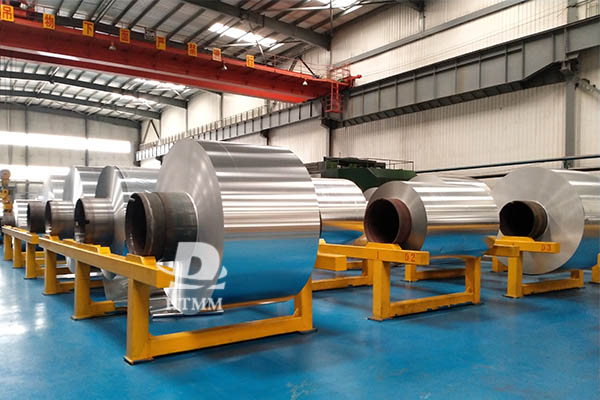
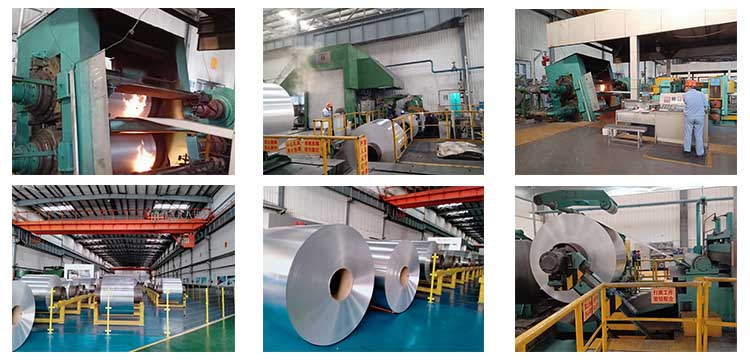
The manufacturing process for large domestic aluminum foil rolls used to make smaller rolls is more rigorous than producing smaller rolls directly, as the quality of the larger rolls directly determines the quality of the smaller rolls. The basic process involves passing through six main stages.
The first hurdle is choosing raw materials. High purity, food grade aluminum ingots are essential, typically 8011 or 8079 alloy. These ingots produce aluminum foil with few impurities, good ductility and adequate toughness, making it less prone to fracture when subsequently cracked into small rolls. Once the raw materials arrive at the factory, they are melted and welded into blanks of aluminum coils a few millimeters thick. The temperature must be precisely controlled in this step, otherwise it will affect the flexibility of the aluminum foil, causing problems during subsequent incision.
The second obstacle is cold rolling to thin the foil. The blank, a few millimeters thick, is rolled repeatedly in a cold rolling mill, just like rolling dough thinners and thinners. After tearing into smaller rolls, it is rolled up to commonly used thicknesses such as 12mic, 14mic, and 15mic, depending on the needs of the finished product. The error must be controlled to within 0.2-0.3 μm; otherwise the aluminum foil rolls will be uneven in thickness, making them either easy to break or difficult to tear.
The third step is annealing and softening. Cold rolled aluminum foil is hard and brittle, and direct shredding will tear it. It is placed in an annealing furnace and heated to a certain temperature to soften it and restore its flexibility, making it easier to tear when rolled into smaller rolls later.
The fourth step is cleaning and degreasing. During the rolling process, a small amount of rolling oil will stick to the surface of the aluminum foil. This oil cannot come into contact with the food and will also affect the flatness during slicing. Therefore, it should be thoroughly washed with a food grade cleaner and then dried at high temperature to ensure that the surface is clean, odorless and residue free.
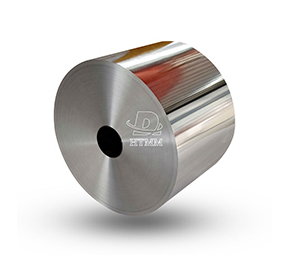
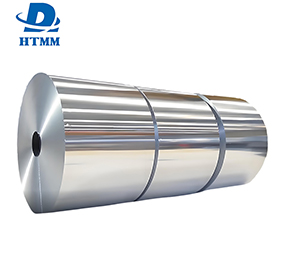
The fifth step is large-roll forming. The cleaned aluminum foil is rolled into wide rolls, usually 100cm. or 120cm. broad, with weights ranging from tens to hundreds of kilograms. The turning force must be even; Too loose and the roll will open, too tight and the aluminum foil will compress, thus affecting the quality.
The sixth step is the finished goods inspection. Larger rolls are sampled to check their thickness, uniformity, and flexibility. Particular attention is paid to testing the amount of heavy metal leaching and cleanliness indicators. It must meet food contact standards. Only larger rolls that pass all tests can be used to roll into smaller rolls. It should be noted here that speed and tension control are particularly important during the production of large rolls, as they are more difficult than producing small rolls directly. Even a slight deflection can nullify the entire roll of aluminum foil, and subsequent rewinding to a smaller roll will cause problems such as uneven edges and numerous bars.
Large rolls of aluminum foil used to make small rolls are food contact materials. Both the large roll itself and the small roll must be supported by authoritative certificates. These credentials are the "what" to export; Without any of these, access to foreign markets is impossible. There are three main types of credentials to focus on. The first type is the Food Contact Safety Certificate, the most basic "entry-level certificate." Domestically produced large rolls must comply with National Standard GB 4806.7-2016. After making small rolls, the packaging of the finished product must also carry this marking to ensure that no harmful substances such as lead or cadmium are released when in contact with food. Target market standards must be met for export: For the US, both small and small rolls must be FDA certified, as the FDA has very strict regulations on food contact products; Only certified products can be sold. For the EU, compliance with (EC) No 1935/2004 is required, as well as REACH testing to ensure that harmful substances in aluminum foil do not cross EU borders. The JIS Z 1650 standard is required for Japan; Japan has very high hygiene standards and more detailed tests than other countries. The second type is a quality management system certification, typically ISO 9001 . This certification indicates that the manufacturer tightly controls every step from raw material procurement and large roll production to small roll shredding and packaging, ensuring stable product quality and preventing larger rolls from toughening one year and breaking easily the next. There is also HACCP certification, especially for food-related products, which focuses on controlling hygiene risks during production and shredding, such as preventing large rolls from being contaminated by dust and oil during transport and storage, and avoiding cross-contamination when tearing small rolls. The third type is a third-party test report, essentially a "health test report" of a product. Reliable manufacturers will have their products tested by authoritative bodies like SGS and BV. The reports will detail the tensile strength, elongation, and temperature resistance of the larger rolls as well as the cutting accuracy and edge smoothness of the smaller rolls. Whether negotiating collaborations with overseas distributors or supplying downstream manufacturers selling smaller rolls, having this report makes the product more convincing.
The export scope of large aluminum foil rolls used for small roll manufacturing is extensive because it is the flexibility in adapting to the different needs of different markets, especially these major international markets.
The first is the European and American markets, such as the United States, Germany, and France. Families in these countries have larger kitchens and often use larger baking pans, 45 cm for roasting whole chickens and pizzas without the need for slicing. or 50 cm. Prefers wide rolls. Moreover, they have high food safety standards; As long as the larger rolls are FDA and EU certified, and the smaller rolls are packaged in English-compliant packaging, market penetration is easy. In addition, the prevalence of home baking and grilling cultures in Europe and the United States creates a high demand for aluminum foil rolls, and the large-roll to small-roll model allows for faster response to market demand and improved supply efficiency.
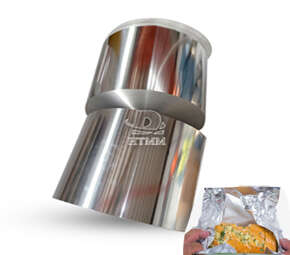
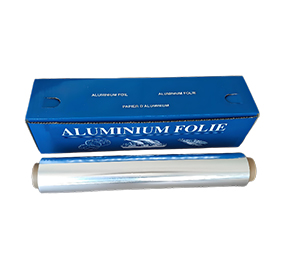
The second is the Middle Eastern market, such as the UAE and Saudi Arabia. Grilling culture is strong in the Middle East, and families often wrap beef and lamb in aluminum foil for cooking, which requires resilient, medium-width rolls; Rolls 14mic thick and 45cm wide are particularly popular. When exporting larger rolls to this region, it is important to control weight when making smaller rolls, ideally lighter rolls of 1-2kg, and halal labeled packaging would be more attractive. The third market is Southeast Asia, such as Thailand, Malaysia, and Indonesia. Southeast Asian families tend to be large, and people like to wrap food in aluminum foil for storing and cooking, but their purchasing power is relatively limited. They prefer lighter weight rolls, usually 30 cm. wide and weighs 0.5-1 kg. The "big roll to small roll" model allows for flexible size adjustments, cost control, and better pricing, perfectly meeting local customer demand. However, the climate in Southeast Asia is humid, so larger rolls require moisture-resistant packaging during transport and the finished product after being rolled into smaller rolls must be tightly sealed to prevent aluminum foil from oxidizing due to moisture. The fourth market is Japan and South Korea. Japanese and South Korean kitchens are relatively small, but the details of their products are in high demand and they prefer small, elegantly packaged aluminum foil rolls, such as 30 cm. Wide and 50m long lightweight roll. When rolling larger rolls into smaller rolls, attention to cutting precision is crucial, ensuring neat, bur-free edges. Packaging design should be simple and elegant. After obtaining the Japanese JIS certification, it will be very competitive in the local market.