Smooth walls and wrinkled walls: not only the appearance
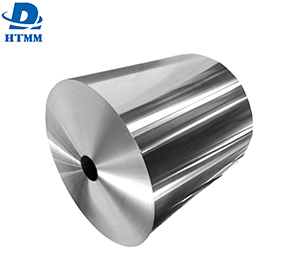
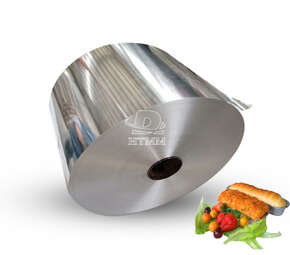
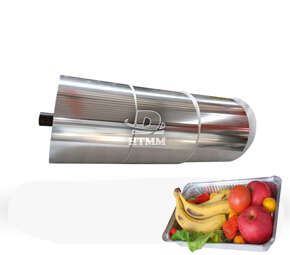
Fold when forming the wall container, the aluminum foil material, which does not require edges, naturally folds and wrinkles, and the molding force is relatively small. On the contrary, the production of smooth wall vessels has a completely different physical principle - this is a "deep drawing" technique, where the aluminum foil is pulled and flowed under huge pressure and sophisticated models, and the excess material is "ironed". Forms smooth, flat walls and excellent sealing function. This essential difference makes the production of smooth wall containers much more demanding for aluminum foil raw materials than for ordinary plated wall containers.
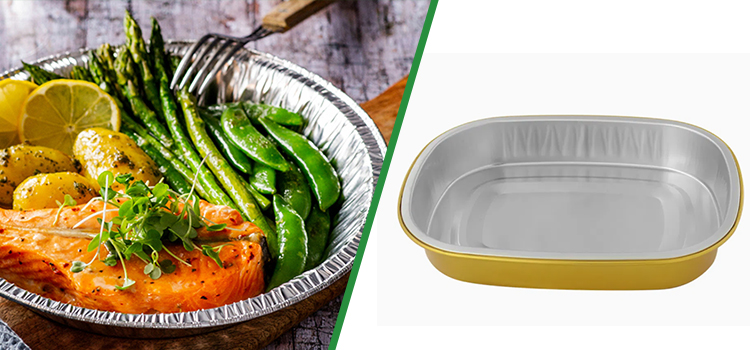
High-quality smoothing to print wall containers, you must first use high-quality aluminum foil as a substrate. In recent years, aluminum foil 3004 has become a new favorite in the industry due to its excellent stamping performance and environmental protection characteristics. 3004 aluminum foil belongs to aluminum manganese-type alloy and combines high strength and good ductility, adding an optimized ratio of manganese-type magnesium elements. After a completely cluttered processing, its best state of plasticity, in the stamping crafts can be easily processed bento black silk, no bright lines, no holes, corruption, wrinkles and other problems that effectively appear in the process of stamping. The elongation of 8006 aluminum foil can be more than 3%, which is resistant to cracking during rolling molding and has proven to be suitable for manufacturing type lunch boxes.
First, there is a precise control over the proportion of the alloy. Alloys containing manganese, iron, silicon, and magnesium have deeper tension than pure aluminum. Among them, some of the alloys are manganese pigment, which is more hard and has the ability to withstand load, so soldering after rolling molding is not easily deformed, and the sealing is good. At the same time, after sufficient antipyretic treatment (special heat treatment work), the ductility and malleability of the aluminum foil are greatly improved, and it is difficult to tear even when pulled deeply.
From big rolling to courage: three important processes
Washing and heating: when removing a large roll type aluminum foil roll, first thoroughly wash and remove the oil. By removing residual oils and fats in the rolling process, they prevent stains after heating and ensure food safety. A subsequent annual process "softened" the aluminum so that the metal was evenly stretched even under deep pulling, thus increasing its plasticity.
Precision coating: wall smoothing is a very important step in the craft. The surface of the aluminum foil is uniformly coated with food-grade lubricating oil. Due to the thick aluminum foil and the large extension and deformation of the aluminum foil during the production process, the choice of high viscosity lubricants ensures excellent lubrication and bearing performance. Common food-grade lubricants are highly volatile, have little residue after heating, and have no impact on food safety.
Stamping molding: sufficient lubrication of aluminum foil feed to a high-speed stamping press, along with a precise mold, through one or more drag, edge and roll processes to quickly become a clean container . Because the smooth wall container needs to completely cover the edge to obtain a good thermal sealing effect, the punch pressure usually reached 80~130 tons, much more than the 45~63 tons of wrinkled wall container. Stamping frequency is usually once every one to two seconds, and a single facility can produce tens of thousands or even hundreds of thousands of finished products every day.
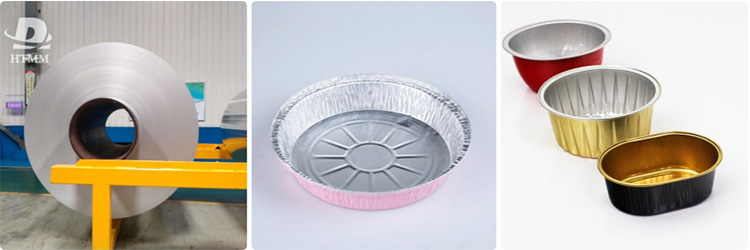
Consumers are most concerned about food safety. Food grade aluminum foils must undergo strict quality inspection before shipment. No stamping oil should remain in the watch, no aluminum shavings or waste should adhere to it, the winding edge should be complete and smooth, there should be no scratching sensation. According to the national food safety standards, aluminum foil meets the requirements of food contact materials that can be in direct contact with acidic and oily foods. It is very thin, but it effectively blocks out gas, water, and light, increasing freshness, and preventing the taste from leaking out.
More importantly, the aluminum foil has the advantage of environmental protection. Unlike plastic lunch boxes, which are difficult to decompose and produce fine plastic pollution, aluminum foil can be recycled indefinitely, and the energy required in the recycling process is less than 5% of the production of aluminum, and greenhouse gas emissions It can be reduced by 95%. The used aluminum foil chamber can be easily washed, pressed and flattened, put into the recovery system and melt the aluminum again, and make a new chamber, wrapping paper, up to building materials. Under the background that the world accelerates the "plastic limit" and green transformation, this is also an important driver for the aluminum foil packaging market to continue to grow.
Zulbi one giant one aluminum foil from rolling machine one aluminum winding, precision alloy adjustment, heat treatment, oil coating lubrication and high speed stemping (STAM. To baoding air companion meal clouds steamed luck, finally we have been leaning on hand one by one turned flat clean, sealed is a gently wall container, delicious delivery also came to our house along one minute. A good package makes your groceries safer and fresher, and the planet more sustainable. Next, when you pick up a high-quality aluminum foil bento with a smooth wall surface, I hope you will be able to imagine the "journey of transformation" behind it.